

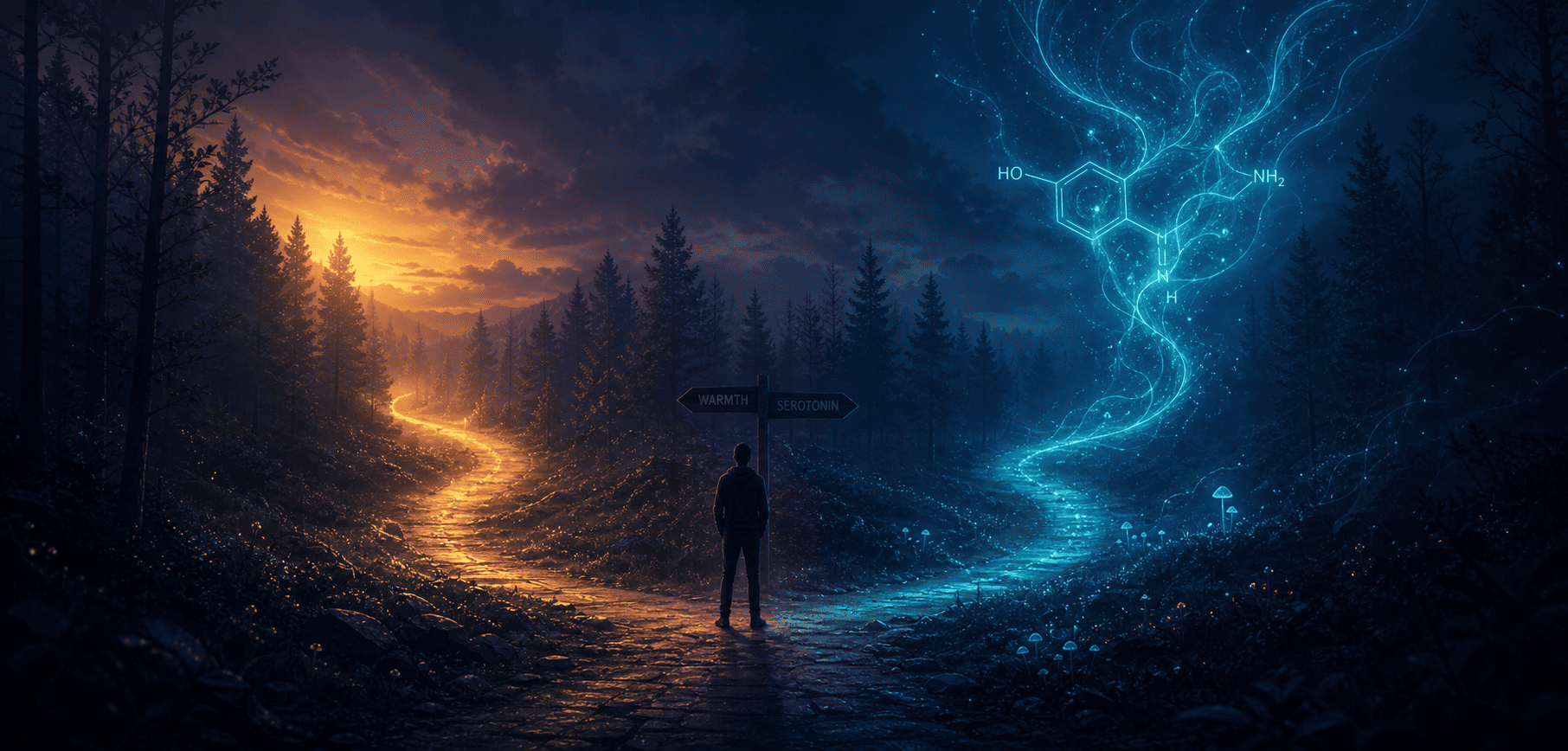
Psilocybin and SSRIs: The Surprising Truth From 12 Studies
If you’re on an SSRI and curious about psilocybin, you’ve probably run into two very different stories about mixing psilocybin and SSRIs: one insists on a hard taper weeks in advance or risks a dangerous reaction, the other says it doesn’t matter at all. Neither captures what the newest research actually shows — and the real answer turns out to be more useful than either extreme.
What the research says
A growing body of trials, meta-analyses, and real-world data has caught up to a question thousands of people were already living with: what actually happens when psilocybin meets an SSRI that’s already in your system?
A 2025 living systematic review pooled results from twelve studies and more than 700 participants and found something fairly consistent: psilocybin’s antidepressant effect holds up whether or not someone continues serotonergic medication. Two of the more targeted studies in that pool looked specifically at people who stayed on their SSRI or SNRI through treatment, and found no meaningful difference in safety or therapeutic outcome compared with those who tapered off beforehand. People who remained on medication reported a somewhat gentler experience — less intensity, fewer overwhelming visuals — but not a smaller benefit.
Earlier clinical work published in Neuropsychopharmacology reached a similar place: patients with treatment-resistant depression who stayed on their SSRI during psilocybin-assisted therapy tolerated it well, with no signal of the dangerous interaction many had feared.
How psilocybin and SSRIs interact in the brain
The mechanism behind combining psilocybin and SSRIs is fairly well understood now. Psilocybin works primarily through the 5-HT2A serotonin receptor — the same receptor system SSRIs quietly reshape over months of daily use. Chronic SSRI use downregulates and desensitises these receptors, so when psilocybin arrives, it has fewer receptors to bind strongly to. That’s the likely reason the subjective experience tends to soften: fewer visuals, less intensity, a gentler ride.
What it doesn’t appear to do is create the serotonin syndrome clinicians once worried about. That risk remains theoretical — discussed in guidance, rarely seen in practice, and unsupported by the clinical data collected so far at psilocybin’s typical doses. It’s still a reason to plan with a knowledgeable prescriber rather than assume nothing could go wrong, but it isn’t the emergency some early warnings implied.
Questions worth asking before you decide
The science doesn’t hand you a rule. It hands you better questions to bring into the conversation.
- Talk to your prescriber before changing anything.
Stopping an SSRI suddenly can cause its own withdrawal symptoms — irritability, brain zaps, disrupted sleep — entirely separate from anything psilocybin-related. - Ask what your facilitator’s actual protocol is.
A reputable guide or clinical setting will have a clear, specific stance on concurrent medication — not a shrug. - Set your expectations around intensity, not outcome.
If you stay on your SSRI, plan for a softer, more manageable experience rather than a smaller one. - Watch the weeks after, not just the session.
The research keeps pointing the same direction: medication seems to change the peak, not necessarily the integration that follows. - Treat “should I taper” as a personal question, not a universal rule.
Dose, medication type, how long you’ve been on it, and your own physiology all shift the answer.
The bigger picture
None of this makes the decision for you, and it shouldn’t. What it does is retire the idea that psilocybin and SSRIs are simply incompatible, or that the only responsible path is a hard taper. The newer, larger, more careful studies point somewhere calmer: this is a conversation to have with a prescriber who knows your history, not a rule to follow blindly.
That’s consistent with everything else we say here about this work. The medicine opens a door. What happens on the other side of it — how carefully you prepare, how honestly you integrate what comes up — matters more than whatever happens to your serotonin receptors on the day.
This article summarises current research for informational purposes and isn’t medical advice. If you’re on an SSRI or any psychiatric medication and considering psilocybin, talk with a qualified prescriber first.
Sources
- Psilocybin treatment for symptoms of depression: a living systematic review, meta-analysis, and data resource — medRxiv, 2025
- Psilocybin for treatment-resistant depression in patients taking a concomitant SSRI medication — Neuropsychopharmacology, 2023
- What if psilocybin works about as well for depression as an SSRI? — Drug Discovery Trends
- Psilocybin: A Clinician’s Guide to Pharmacological Interactions — Psychiatric Times